The land that makes up Massachusetts is crisscrossed by old stone walls and meandering rivers, rooted with woodlands and wildflower-laden meadows, framed by white-capped waves in the East and mountains in the West. But the Massachusetts landscape is more than just soil, stone, stream, and flora—it is a repository of intersecting layers of human and ecological history.
Visitors to the more than 120 Trustees properties are invited to reflect on those legacies with each hike, museum visit, picnic, and paddle. This summer, a fresh lens is trained on four special places as the Trustees’ Art & the Landscape public art program marks ten years of commissioning site-specific artist installations for Trustees properties.
Curated by Tess Lukey, the Trustees Associate Curator of Native American Art, The Land Tells Our Stories presents thoughtful new works by three contemporary female artists, each examining a different facet of the land’s relationship to our human presence over time, as well as our hopes, fears, and influence over its future. Says Lukey, “We’re in a time of big global crises and a real disconnect from the natural world. Art has this wonderful way of talking about those tough things while pointing toward healing and inclusion.”
We're in a time of big global crises and a real disconnect from the natural world. Art has this wonderful way of talking about those tough things while pointing toward healing and inclusion.
– Tess Lukey
Standing Solid Against the Tides
Second Wind by Pamela “Posey” Moulton at Castle Hill
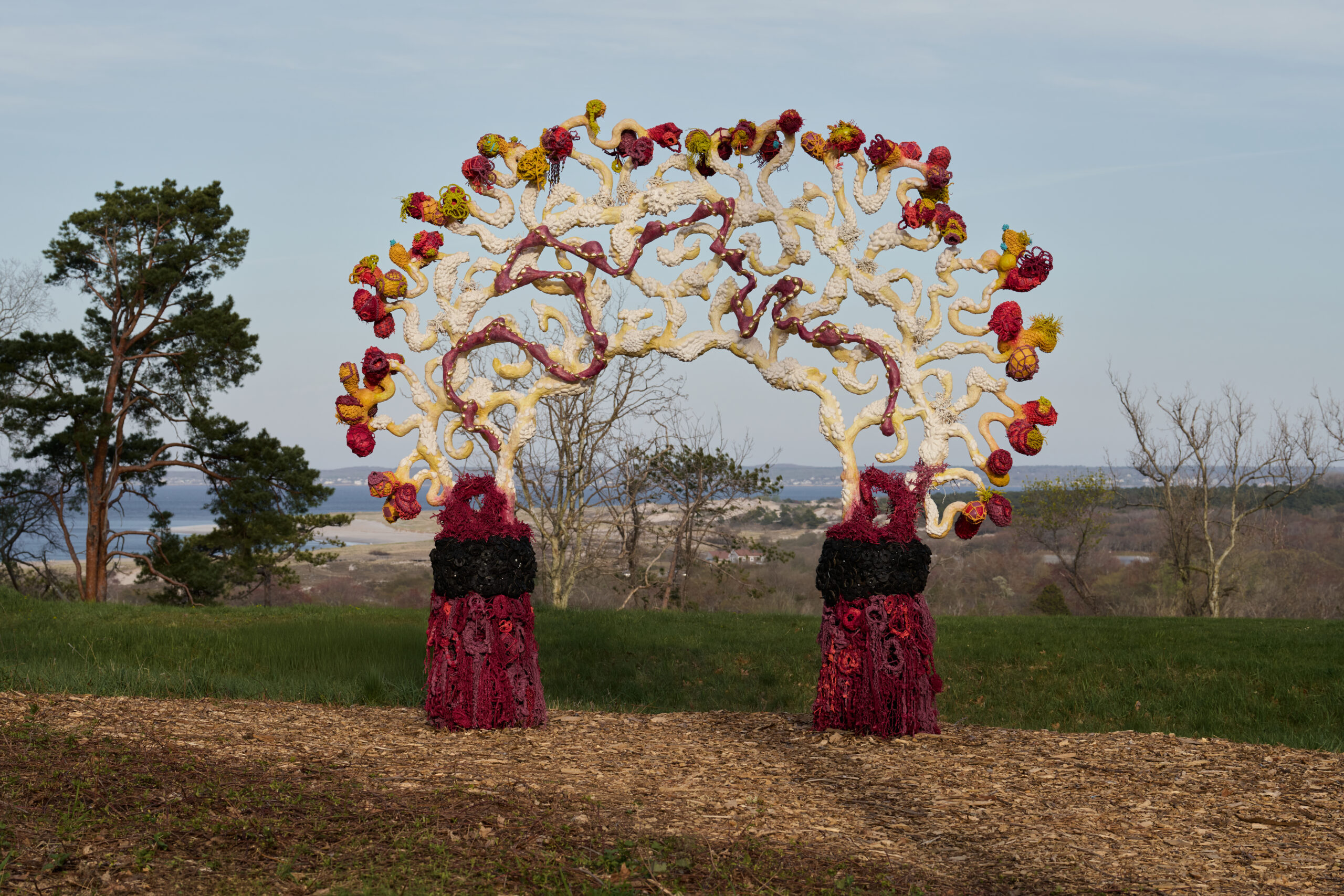
Located behind the Great House at Castle Hill on the Crane Estate, Ipswich, “Posey” Moulton’s Second Wind stands like a magical gate to the expansive vista of Crane Beach and its surrounding salt marshes, far below. The sculpture’s colorful armature is bedazzled with marine industry detritus known as “ghost gear.” It stands sturdy on two galvanized steel legs, festooned in cement and resin-stiffened, reclaimed fishing nets and chainmail crafted from “rockhoppers,” hard black rubber discs used in marine trawling.
She’s sporting some surprisingly bright colors, too: fuchsia, lavender, marigold orange, mustard yellow, and gold—hues that are striking in contrast to the ombre greens, blues, and sand tones of the seaside landscape stretching out below.
“[The color] was pretty toned down for me!” laughs Moulton. “We need color so badly, we need joy—bright colors are like blossoms or plants coming to life.”
The sculpture’s undulating, globular forms—which the artist identifies as “alveoli”—are reminiscent of bladderwrack, a type of seaweed. Intriguingly, they sound of hollow metal when tapped. It’s another contrast; so unlike the rubbery real thing. With it’s slightly larger than human scale, Second Wind invites interaction and observation from all sides. Pass beneath its arch, then sit to contemplate the view of the ever-changing dunes and salt marsh. Walk back through to traverse the rolling Grand Allée all the way to the edge of Steep Hill (while the theme song from Downton Abbey lives rent free in your head.)
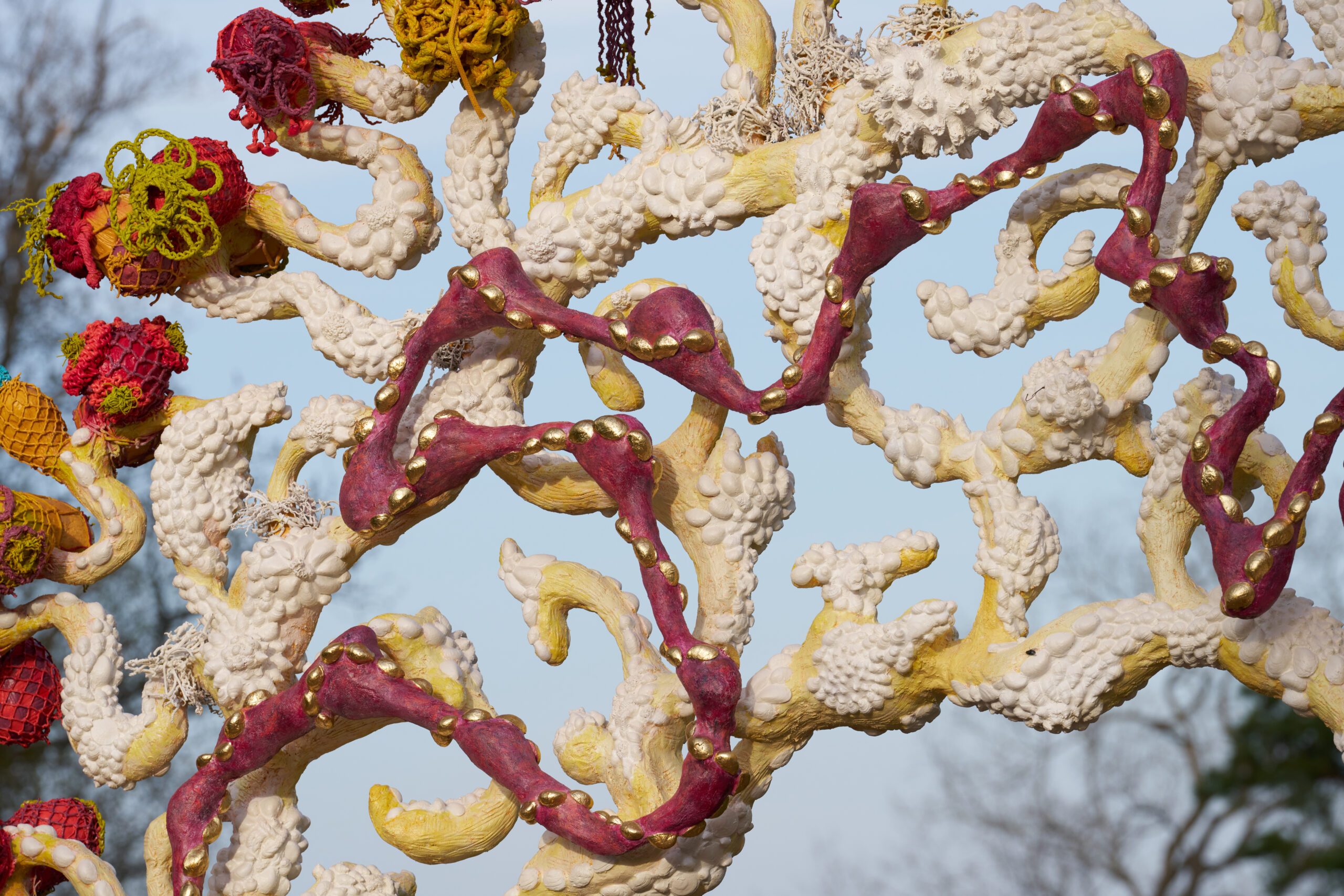
Detail of "Second Wind". Photo by Chris Cardoza, Doza Visuals
The Stories in These Stones
Moshup’s Hand by Ella Mahoney at Rock House Reservation
Rock House Reservation is an off-the-beaten-path destination in West Brookfield. During the last Ice Age, nature’s sticky hand dragged large boulders through the landscape, dropping them here and there like children’s toys. Ella Mahoney (Aquinnah Wampanoag) chose one such dramatic and prominent tumble of boulders for the site of her sculpture, Moshup’s Hand.
In Wampanoag and nearby coastal tribes’ oral histories, Moshup was a benevolent giant who lived peacefully with the first peoples. Mahoney recounts a tribal legend in which the hero dragged his toe through the water to carve out the islands of Martha’s Vineyard and Nantucket, and the coast. Seeing the glacial deposits at Rock House for the first time, she immediately knew, “This is where the story goes.”
Before settler colonization, this area was a sheltering place for Indigenous communities. It offered protection from the elements, running water, and woods for foraging and hunting.
Moshup’s Hand is embodied by a metal framework perched atop the property’s signature rocks, which create a natural lean-to against the elements known as the “Rock House.” Suspended from the teal frame are silk banners hung in concentric circles and strings of “mermaid’s toenail” shells, fluttering in the wind. The banners are painted and cyanotype-printed with depictions of plants and seaweed, alternating with white silhouettes of figures performing circle dances that are still proudly practiced at contemporary pow-wow gatherings.
Moshup’s story “is a creation story to Wampanoag people,” notes Mahoney, but “it’s continuing to be told about this landscape.” The banners and shells moving in the wind sing: “We’re still here… dancing.” “It was important that we [engaged] an Indigenous artist from a local tribal community,” noted Lukey, who, like Mahoney, is also of Aquinnah Wampanoag heritage. “So much of placemaking is tied to traditional ecological knowledge and Indigenous perspectives.”
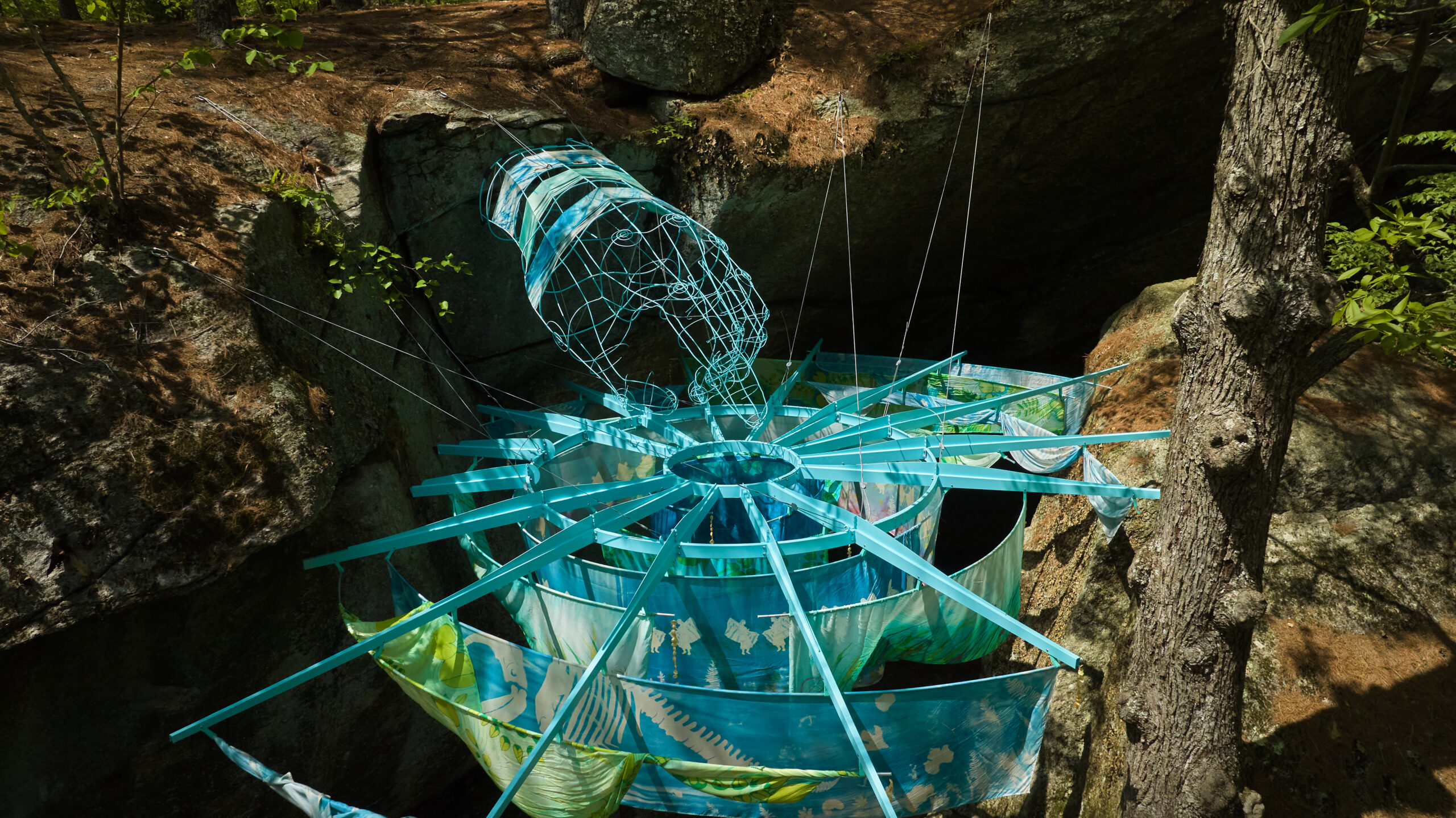
"Moshup's Hand" Photo by Chris Cardoza, Doza Visuals
Stewarding the Future Coastline
Seaside Chestnuts by May Babcock at Moose Hill Farm
Ecological knowledge comes to the forefront at Sharon’s Moose Hill Farm, where artist and papermaker May Babcock was surprised to encounter rare mature American Chestnut trees on her first site visit.
This endangered population was mostly lost to blight in the last century, but was once as common as a maple tree, according to the artist. Inspired by the Moose Hill chestnuts’ survival against disease and climate change, she teamed up with the American Chestnut Foundation to create her installation, Seaside Chestnuts. The Foundation scientists supplied eleven young hybrid chestnut trees, which were planted in May.
“Their [mission] is to make a blight-resistant version of American Chestnut, by hybridizing with Chinese Chestnut, so they can restore it to eastern North America,” reports Babcock. “I thought that was fascinating, as a Taiwanese American [in New England.]”
Babcock created enclosures to protect each immature tree while they establish strong roots and grow tall enough to avoid bark-nibbling deer and other pests. She formed these from repurposed cattle fencing she found in the Moose Hill barn. To this she applied layers of surprisingly durable paper pulp crafted from regionally cultivated flax fibers combined with milkweed and other plants she foraged on-site. “I used goldenrod for color and black walnut, which makes that beautiful chocolate, dark brown,” notes Babcock.
The obvious question is: How can a paper fence endure, never mind protect a vulnerable tree from the elements? “Flax is a very strong fiber,” Babcock reassures me. “There’s something about our modern culture that doesn’t know how to deal with states of impermanence and that things change, but that’s just the way things are.”
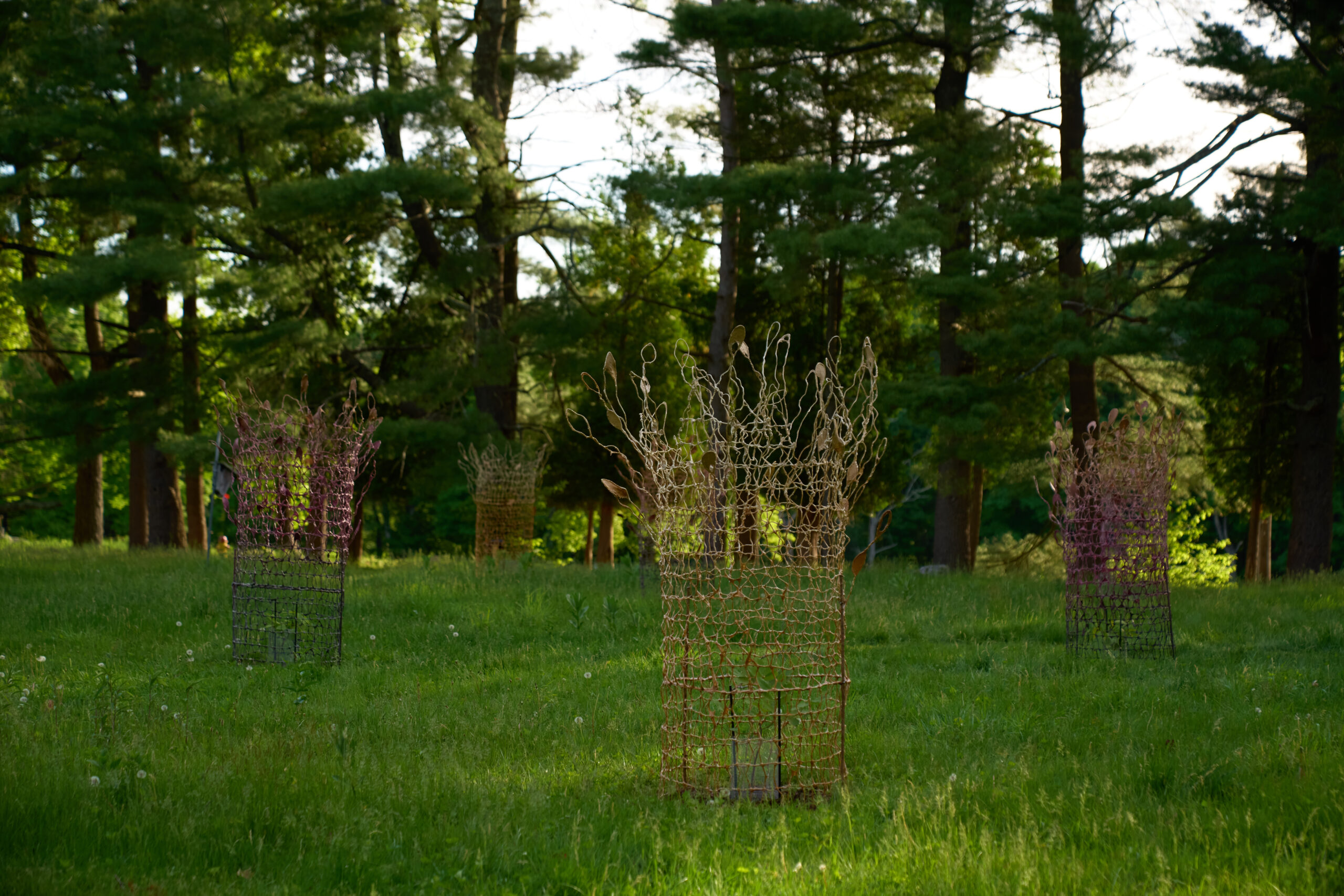
"Seaside Chestnuts" Photo by Chris Cardoza, Doza Visuals
Behind the Stories
Exhibition Gallery at Fruitlands Museum
Each installation stands on its own, but for a behind-the-scenes perspective, visit the Seasonal Gallery at Fruitlands Museum in Harvard. “This is the exhibition’s process gallery, so it’s talking about the works, the artists, all of the materials that are used, the histories of the sites, and the collaborators that were involved,” explains Lukey. “There’s a spot where young minds can interact and play with the materials that these works were made of. There’s so much learning that can happen that way.”
There is also a narrative video featuring Lukey and each of the artists in their own words, along with project collaborators.
The Fruitlands exhibition, as well as Moshup’s Hand, will be up through the end of October 2026. Second Wind will be on view until Summer 2027. And Seaside Chestnuts, if all goes to plan, will be around for a long, long time.
Meredith Cutler is a freelance arts writer and communications consultant based in Boston’s MetroWest.