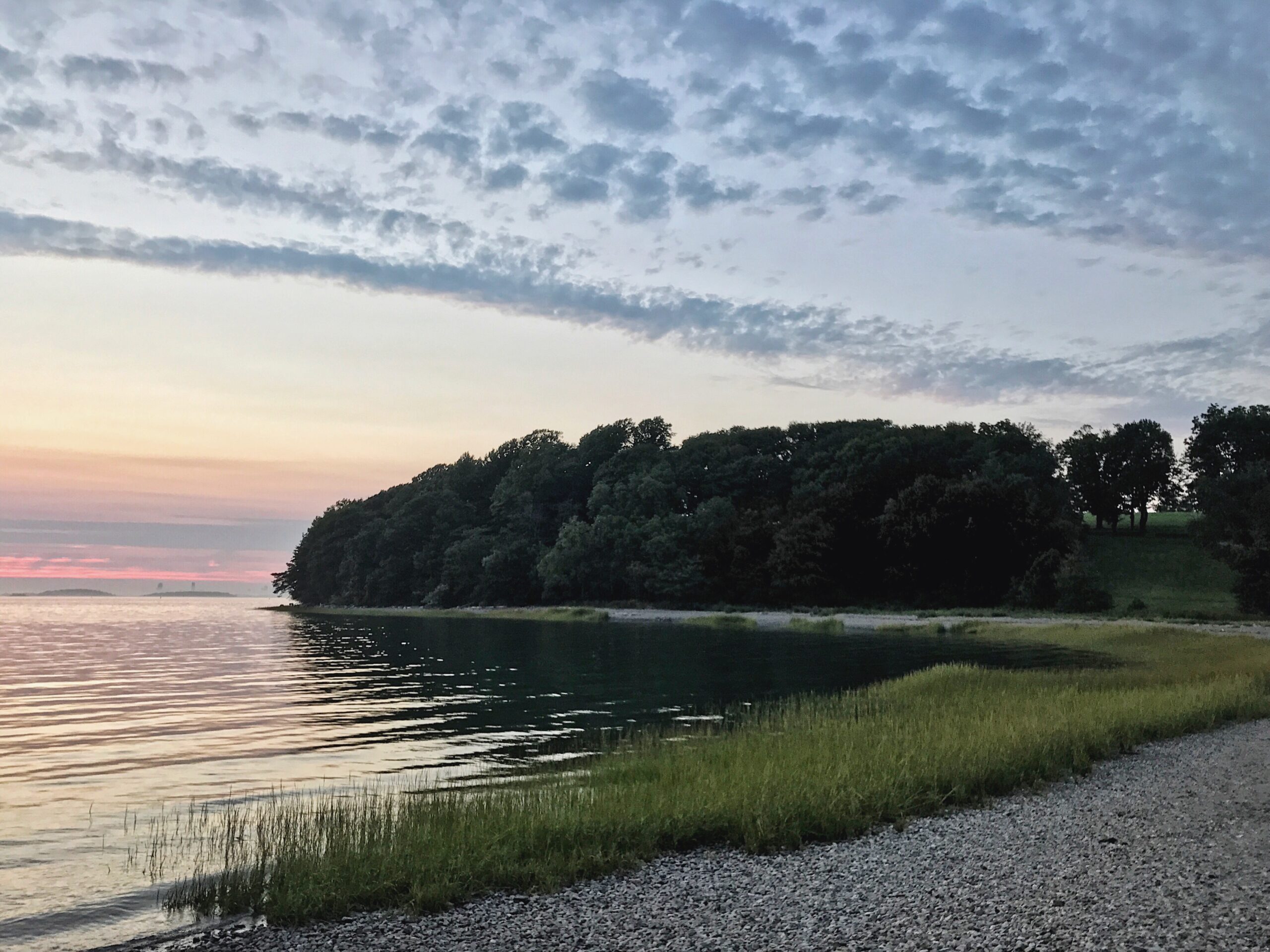
Photo by Peter Marotta
Videos Courtesy of Center for Coastal Studies.
This project has been funded in part by the United States Environmental Protection Agency under cooperative agreement 83967501 to Restore America’s Estuaries. The contents of this document do not necessarily reflect the views and policies of the Environmental Protection Agency, nor does the EPA endorse trade names or recommend the use of commercial products mentioned in this document. For more information, please see estuaries.org.
- English
- Español
- Português
English
Salt Marsh Restoration
Damde Meadows, a 14-acre tidal basin within World’s End, was historically a salt marsh. It was disconnected from tidal exchange with Hingham Bay in the early 1700s for conversion to non-tidal agricultural land that was used for upland haying, among other things.
In 2017, the dikes (barriers used to regulate or hold back water) that had separated the basin from the bay were removed. A bridge was installed to restore tidal exchange, improving water quality and wildlife habitat through the restoration of salt marsh. While salt marsh has slowly returned as a narrow band along parts of the upland edge of Damde Meadows, most of the basin remains mud flats due to 200 years of settling and compaction without tidal exchange. Expanding the amount of salt marsh at this site will raise the elevation of the basin and reduce the amount of water flowing into and out of the basin daily, reducing the threat of future flooding and erosion with sea level rise while restoring valuable salt marsh habitat.
The Trustees is exploring ways to help build back this salt marsh ecosystem. A technique that will be explored here uses the placement of hay bales in the shallowest areas of the basin to provide better growing conditions for salt marsh grasses, particularly Smooth Cord Grass (Spartina alterniflora). The bales will help capture and hold sediment so that cord grass can take root. The current water depth and soil conditions are believed to be keeping cord grass from growing. Hay bales will be composed of salt marsh hay that includes cord grass seeds. The benefits of using hay include its low cost, ease of sourcing and transport, and the ability to be placed by hand to reduce environmental impact.
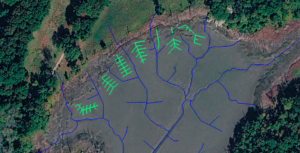
Cross section of haybale design (Credit: Northeast Wetland Restoration)
“The Bar” is a narrow area of low-lying land that connects the outer drumlins (the hills) of World’s End to the mainland of the property. Historically, salt marsh lined both sides of the bar, but in recent years, much of the salt marsh has disappeared as sea levels have risen, and wave action has eroded the marsh.
To restore salt marsh to “The Bar”, The Trustees is exploring the use of wire traps (lobster-style traps) to reduce wave energy. This effort is based on initial success with a pilot project in Swansea, MA, conducted by Ian Sloane (Principal, Ian Sloane Landscape Architectural Consulting) to address a similar scenario. The Swansea pilot demonstrated that these traps could protect salt marsh by reducing wave energy and allowed the marsh to recover. If successful at Worlds End, this pilot project may be expanded at “The Bar” and elsewhere to create resilient coasts.
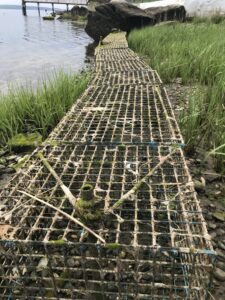
(an example of a similar technique in Swansea)
The World’s End saltmarsh restoration projects together will serve as a learning site for local communities and those also working on salt marsh restoration statewide and beyond. Damde Meadows and “The Bar” are ideal locations to pilot innovative, small-scale, and low-cost restoration strategies to help restore salt marsh. They are sheltered from storms, there is excellent access, and there is a goal to restore salt marsh habitat. With more than 1,500 miles of coastline and 45,000 acres of salt marsh in Massachusetts alone, affordable options are critical if our vulnerable salt marsh is to be saved in the coming decades.
Español
RESTAURACIÓN DE MARISMA SALINA EN PROGRESO
En 2017, esta área se reconectó a Hingham Bay. Desde entonces, el desarrollo de la marisma salina ha sido lento. The Trustees está utilizando una solución para acelerar la restauración de la marisma salina y reducir la amenaza del aumento del nivel del mar.
En los últimos años, la marisma salina a cada lado de “The Bar” se ha erosionado debido al aumento del nivel del mar y las olas. The Trustees está llevando a cabo una prueba piloto con una técnica de bajo costo para restaurarla a fin de regular este punto de acceso fundamental.
Este proyecto cuenta con la financiación de la Agencia de Protección Ambiental de Estados Unidos bajo Restore America’s Estuaries. Para más información, consulte estuaries.org.
Português
RESTAURAÇÃO DO PANTANAL SALINO EM ANDAMENTO
Esta área foi reconectada à Baía de Hingham em 2017. Desde então, o pântano salgado vem se desenvolvendo lentamente. A organização The Trustees está utilizando uma solução baseada na natureza para acelerar a restauração do pântano salgado e reduzir a ameaça da elevação do nível do mar.
Os pântanos salgados de ambos os lados do “Banco de areia” (The Bar) vêm sofrendo erosão nos últimos anos devido à elevação do nível do mar e às ondas. A organização The Trustees está testando uma técnica de baixo custo para restaurar os pântanos salgados, a fim de proteger esse ponto de acesso crítico.
Este projeto foi financiado em parte pela Agência de Proteção Ambiental dos Estados Unidos, no âmbito do programa “Restore America’s Estuaries”. Para mais informações, acesse estuaries.org.