Remote monitoring of wildlife at Trustees properties yields insights for conservation
By Beth Moore, Trustees Staff
What stories unfold at Trustees properties when we aren’t there to see and hear them?
This question has become an important one for the organization’s land stewardship efforts in recent years, as Trustees ecologists install remote monitoring equipment to track the presence and habits of wildlife more intentionally at Trustees special places. Using two methods of remote monitoring—trail cameras and audio recording units (ARUs)—Trustees scientists place additional eyes and ears on properties to observe wildlife in action, noting trends, behaviors, and interactions that enlighten us about beloved habitats, and inform the organization’s approach to stewarding them responsibly.
“Our primary goal in using remote monitoring equipment is to identify the species present on Trustees properties so we can make informed land-management decisions that benefit wildlife,” says Trustees ecologist Jeff Denoncour. “We focus particularly on Species of Greatest Conservation Need identified in the Massachusetts State Wildlife Action Plan. We deploy equipment where these species are likely to occur to see if they are present, and also within habitats we actively manage for these species.”
Trail cameras and ARUs are minimally invasive and flexible—they allow for simultaneous recording from multiple locations on a property at any time, day or night. Most recently, these efforts have informed land stewardship efforts at several of the organization’s coastal and island properties on Martha’s Vineyard and Nantucket, on the Crane Estate in Ipswich, and at Ward Reservation in Andover.
Keeping an Eye with Trail Cameras
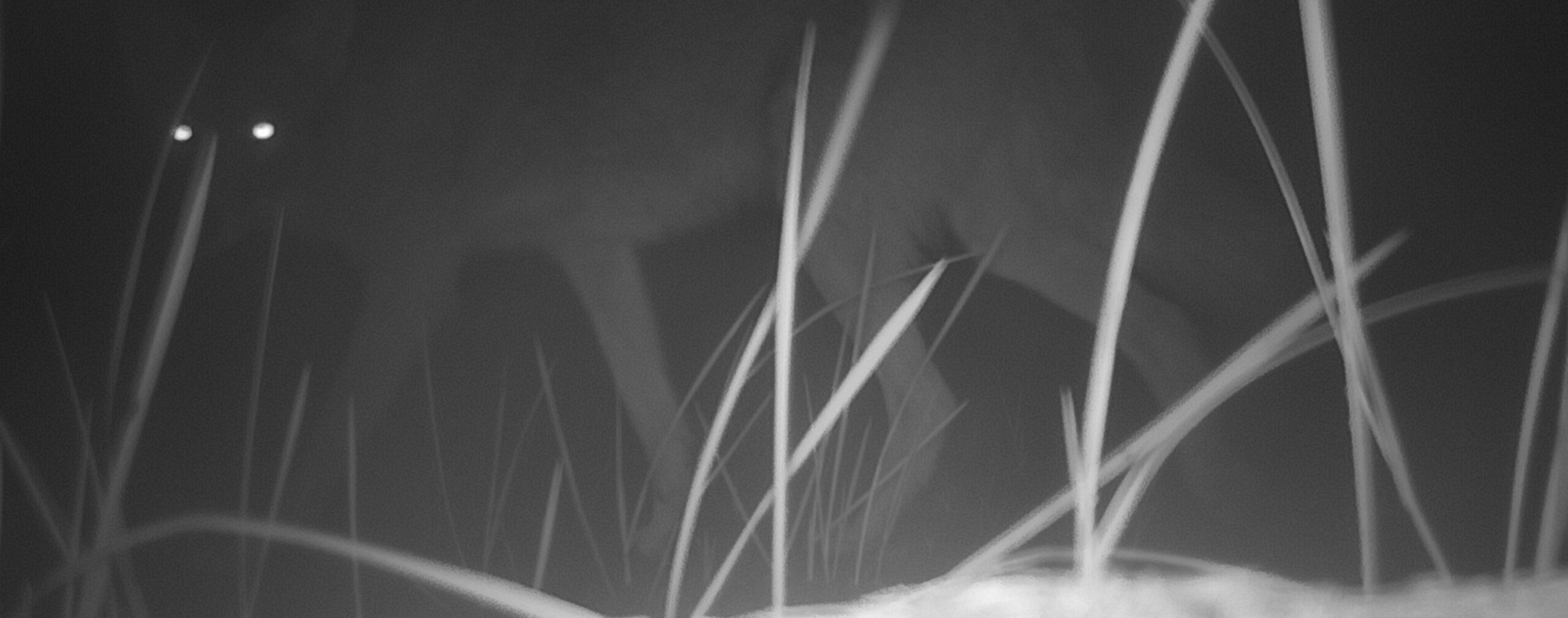
Trustees scientists use trail cameras to observe interactions between many different species across Trustees properties, particularly those between predators and prey. On the Vineyard and Nantucket, ecologists use trail cameras to monitor shorebird populations.
“Understanding more about predator activity as it relates to beach nesting birds is invaluable,” says Trustees Coastal Ecologist Shea Fee. “It allows us to apply targeted predator management strategies that give our birds the best chances of success.”
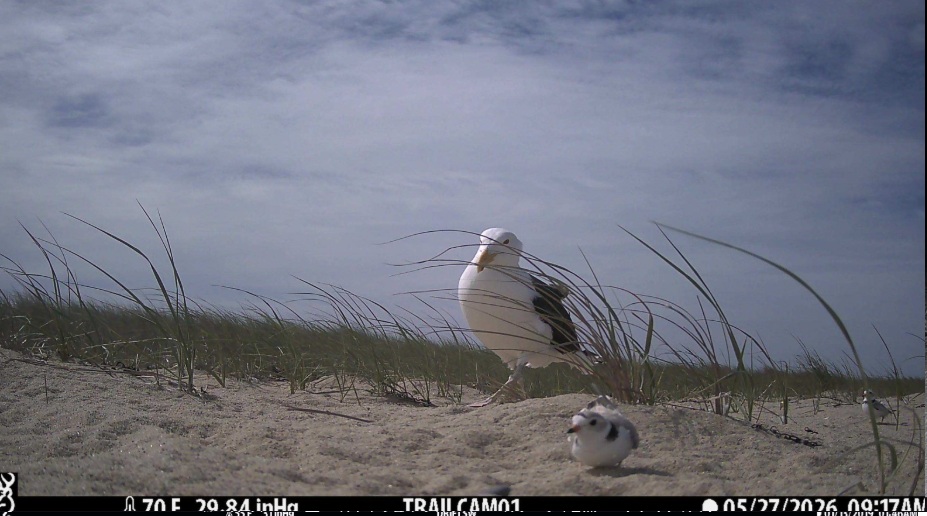
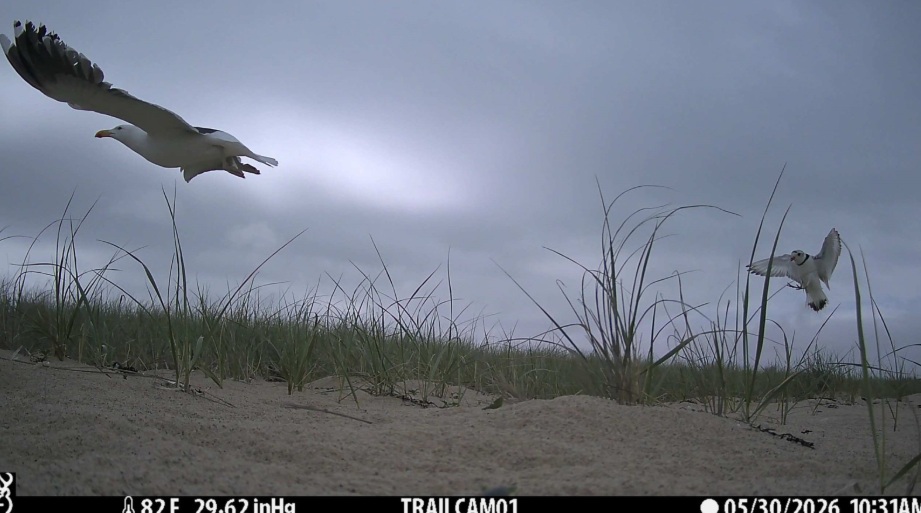
On Martha’s Vineyard, trail cameras have revealed novel insights about Piping Plover populations and the predators that pursue them, informing the organization’s approach to protecting these species and stewarding their habitats. Here, special nest protection tools called exclosures—a kind of small cage placed around a nest—protect plover eggs from predation. Exclosures allow plovers to move in and out of their nests freely, and exclude larger predators such as racoons, crows, and skunks. However, exclosures are not foolproof, and clever predators can find ways around them to access the birds and eggs inside or capture birds as they leave them.
Piping Plover parents at Coskata-Coatue Wildlife Refuge, in Nantucket, defending their nest from Great Black-backed Gulls
“Shorebird technicians monitor our exclosed nests daily,” says Fee, “but having cameras allows us to see what happens when we are not there. If we notice avian predators perching on the exclosure consistently, or mammalian predators spending a lot of time around them, we may choose to remove the exclosure to avoid losing an adult plover.”
Predator/prey interactions captured on camera have already influenced ecologists’ decisions about where to use exclosures on the Vineyard in the future, and this method promises to inform stewardship efforts at Nantucket’s Coskata-Coatue Wildlife Refuge as well. Here, trail cameras similarly observe shorebirds, including a Least Tern colony, individual Piping Plover nests, and American Oystercatcher nests.
Trail cameras have also been helpful to The Trustees in their efforts to observe whether Blandings turtles (a state listed turtle) are present in the wetlands at Ward Reservation in Andover.
“Cameras were set up on basking logs and set to a timelapse mode to take pictures every five minutes, in addition to motion-triggered images,” says Denoncour. “Staff then scanned through thousands of timelapse images to see if they captured Blandings turtles basking on the logs.”
In this instance, the most important takeaway from the effort was not what the cameras captured, but what they didn’t. The cameras caught no footage of the turtles, signaling to ecologists that additional management to benefit that particular species might not be beneficial at this location. In this way, trail cameras allow ecologists to draw important conclusions from both what is and isn’t seen, informing a holistic, responsible approach to land and species conservation at The Trustees.
Listening in with ARUs
Audio recording units (ARUs) have also proven helpful to the organization’s efforts to steward the lands and species under its care. This equipment is sensitive, capturing not only wildlife sounds easily heard by the human ear—such as bird and frog calls—but high-pitch frequency sounds such as bat sonar.
“Technology has really improved over the years,” notes Denoncour. “The wildlife acoustic meters used to be large and heavy, powered by 4D batteries, making it very cumbersome to get into the field. The newer equipment fits into the palm of your hand, with even greater abilities.”
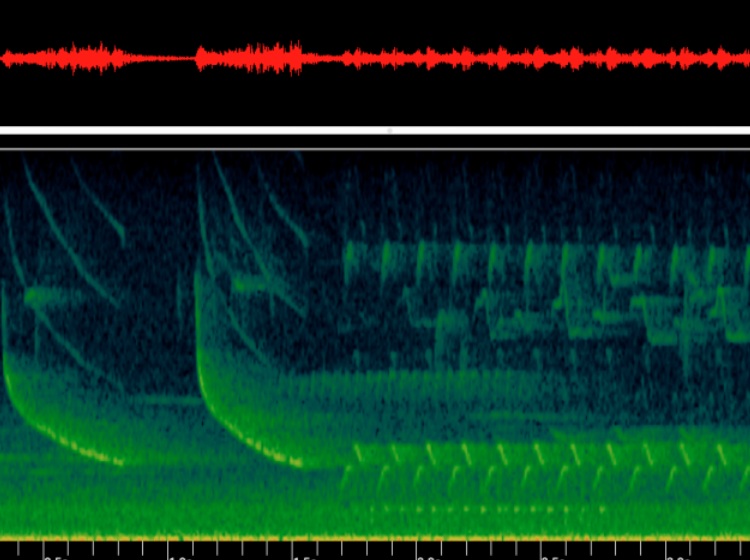
Recordings generated by ARUs also integrate with software that makes analysis more efficient and insightful for scientists. Using programs like Kaleidoscope, Trustees ecologists visualize wildlife calls in graph-like images called spectrograms, easily parsing through hundreds of hours of recordings.
Spectrogram of a North American Cardinal call (bottom image)
ARUs and associated technologies provide useful insights about the presence or absence of wildlife on the Crane Estate in Ipswich, and Wasque on Chappaquiddick Island, that inform stewardship of these special places.
“Since 2016, we have been deploying remote wildlife acoustic equipment to determine the presence of the Eastern Spadefoot toad (a species listed under the Massachusetts Endangered Species Act) on Crane Beach,” says Denoncour. “Remote acoustic recorders set to go on at 8PM and off at 8AM have been placed at multiple maritime interdunal swales (vernal pools of the dunes) where the toads breed and would be vocalizing during the breeding season.”
Like trail cameras, ARUs are enlightening for both what they do and do not capture. While the Eastern Spadefoot Toads at Crane Beach remained elusive, ecologists documented many other species on the property who might benefit from a particular method of stewardship, including American Toads, Fowler Toads, Gray Tree Frogs, Eastern Towhee, Field Sparrows, Owls, and Coyote. “We were even able to capture some unique moments,” says Jeff, “like a Whip-poor-will (a species listed under the Massachusetts Endangered Species Act) calling with the Boston Pops playing in the background at the Crane Estate for our organization’s 125th anniversary celebration in 2016.”
Hear a Whip-poor-will’s call alongside the Boston Pops playing at the Crane Estate
At Wasque, too, ARUs listen for bird and bat calls, and the data they collect informs both Trustees and partner organizations’ stewardship efforts.
“In a collaborative effort with the Biodiversity Research Institute (BRI), a Song Meter SM4BAT FS unit was installed at Wasque,” says Fee. “BRI is interested in monitoring bat presence, activity, and migration patterns in relation to offshore wind development.”
ARU recordings have shed light on when particular bat species are present in and around the property, recently showing that while Eastern Red, Big Brown, and Silver Haired bats use the property in all seasons, Hoary bats and possibly Little Brown bats were only present in August. This data helps both The Trustees and BRI better understand seasonal bat movements in and around Wasque, and will inform best practices for offshore wind industry to help conserve bats during their migratory period.
Your Eyes and Ears: Get Involved
Observing and protecting wildlife isn’t a task relegated only to Trustees ecologists. For Trustees Members and visitors interested in the wild stories unfolding at their favorite special places, there are plenty of enjoyable ways to watch, listen, learn, and lend a hand.
“Both camera and audio monitoring create a huge amount of data which takes time to organize and analyze,” notes Fee. “We could always use help from volunteers to look through photographs or identify bird songs on audio recordings.”
Visitors can also use free apps like iNaturalist and eBird to document species observed during visits to Trustees properties, as this information also informs how the organization stewards habitats and species.
In the end, the act of paying attention is often its own reward.
“What I enjoy most about remote monitoring is reviewing the data after we retrieve the equipment,” says Denoncour. “It feels like opening birthday presents—you never know what you will find.”