Founded in 1638, Appleton Farms is the oldest continuously operated farm in America and among the most influential in America’s agricultural history. It was also home to nine generations of Appletons – from 17th century English emigrant Samuel Appleton to 20th century lawyer Francis R. Appleton, Jr.–who loved their bucolic farm in Ipswich, Massachusetts. This year, as we celebrate our nation’s 250th anniversary, it is serendipitous that we should discover the provenance of an Appleton portrait of George Washington, one of our founding fathers and the nation’s first president.
In addition to the farm’s rich history, there were collectors in the family. The most passionate among them was Daniel Fuller Appleton (1826-1904), a seventh-generation Appleton whose impacts on his family farm were great. As an entrepreneur, Daniel Fuller also became the first Appleton to derive the largest sources of his income from his industrial career rather than from the farm. With his primary residence in New York City, Daniel Fuller Appleton amassed a diverse collection of antiques, many of which could be categorized today as “Patriotic Americana.” This rich collection, inherited by The Trustees as part of the 1998 bequest, includes such highlights as: a full set of presidential signatures; historical mezzotints; varied ceramic objects depicting Washington, Franklin, and Lafayette; and
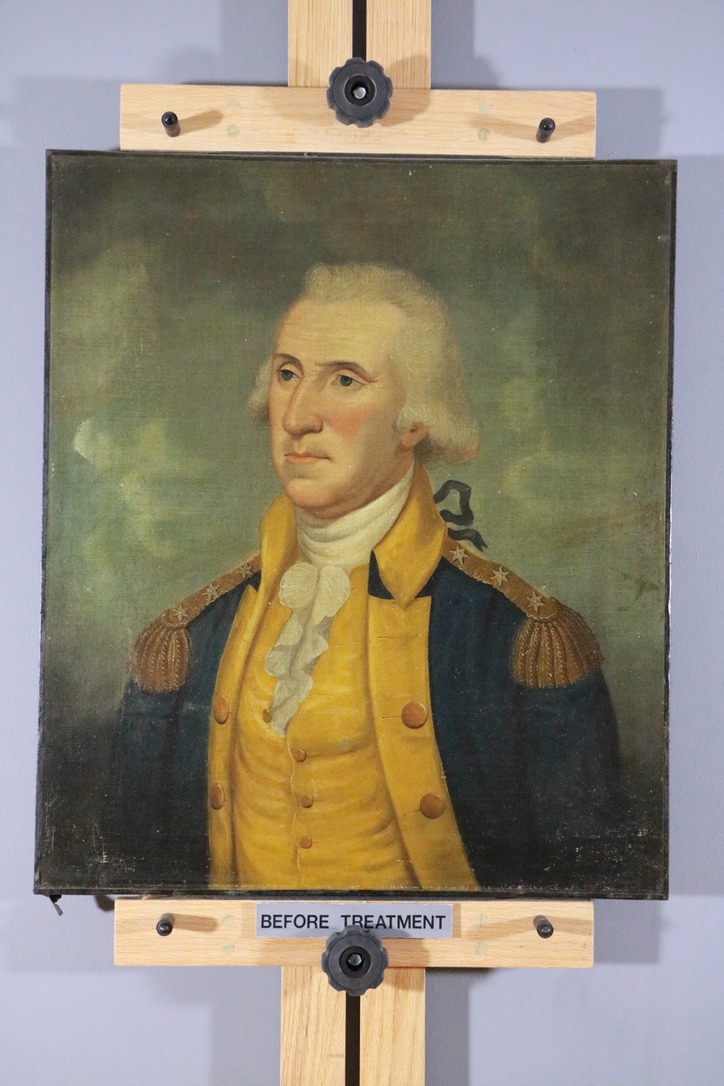
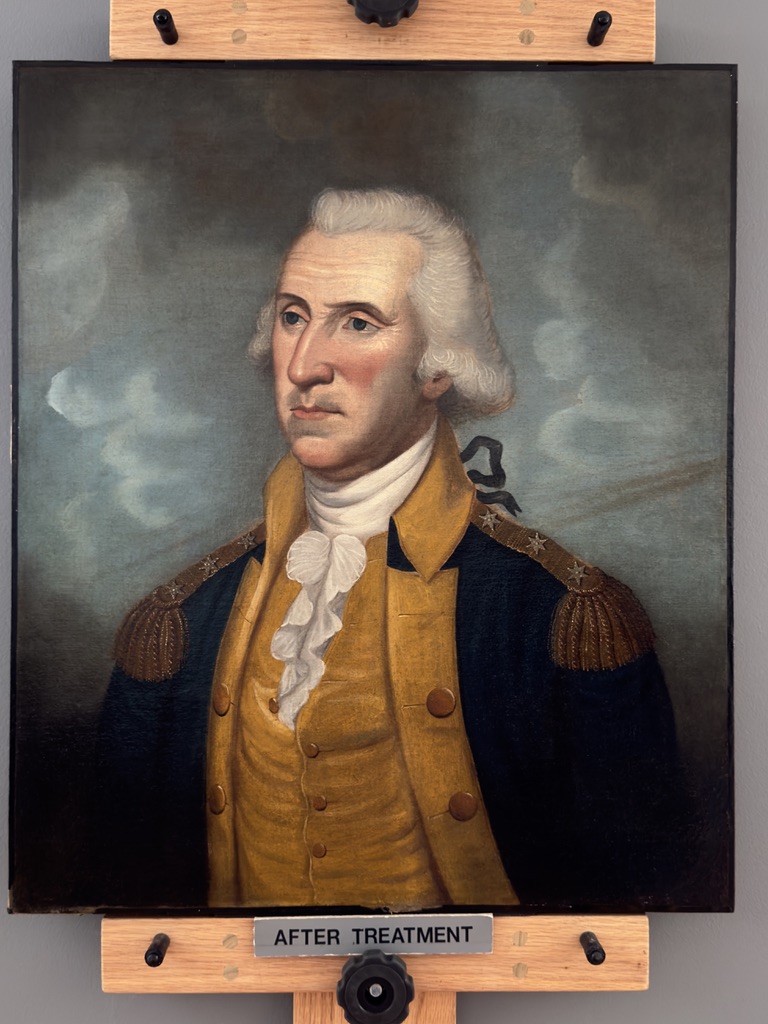
a striking, bust-length portrait of George Washington. It is this unsigned, oil-on-canvas portrait for which we have newly discovered provenance information, including the artist, the first owner, and their connections to Revolutionary War-era America.
Fast-forward to the winter of 2026 – 100 years after the birth of DFA – when I discovered a nearly identical portrait up for sale at the Christie’s Americana sale. That painting had recently been deaccessioned by Preservation Virginia to benefit their collections fund, as I learned from their Director of Interpretation and Collections Elyse Werling, whom I met on my Attingham Summer School sabbatical in 2024. The Virginia portrait was attributed to Charles Peale Polk (1767-1822) and was dated to “circa 1798.” Polk was an itinerant painter whose uncle, surrogate father, and teacher was famed painter and Pennsylvania Academy of Fine Arts founder Charles Wilson Peale (1741-1827). How did this painting come to the Appleton family? Research is still ongoing, but we can share the facts: Charles Peale Polk as the artist has been authenticated; we have archival evidence that a “Polk” existed in the collection of Daniel Fuller Appleton from a 1921 appraisal; and a hint at the portrait’s early history, as deciphered from a partial, hand-written note on the reverse of the painting, appears to be true. We have also just had the portrait cleaned by Geraldine Brooks of Carmichael Art Conservation, and she believes that a circa 1799 date for the portrait is consistent with the paint, canvas, and materials used.
The partial note on the reverse is dated 1888, leading our curatorial staff, a cataloguer, and three appraisers between 1998-2015 to believe that the unsigned portrait was likely a centennial piece, indicative of the resurgence of Washingtonia after America’s centennial celebrations in 1876. However, taking another look at the note and the inclusion of the name “Alexander Balmain,” prompted new considerations about the painting’s date and how it might actually be related to this Revolutionary War-era figure.
More often than not, notes on the backs of paintings and other antiques often turn out to be legends or partial truths. In this case, we discovered that there was, in fact, not only one portrait of George Washington by Charles Peale Polk, but several. Among the various versions, we found out that that one of those portraits was indeed previously owned by Alexander Balmain (1741-1821), a Scottish émigré and Episcopal minister in Winchester, Virginia, who supported the American cause and had direct dealings with George Washington. We also found out that Polk visited Winchester in 1799, so it would almost certainly have been painted during that year.
In addition to speaking with Christies’ Americana specialist and researcher Martha Willoughby, who provided valuable provenance information about the portrait for their January sale and generously helped us with our leads, a particularly helpful resource was the catalogue for a 1981 exhibition on Charles Peale Polk. Titled, Charles Peale Polk (1767-1822): A Limner and His Likeness, it was held at the Corcoran Gallery of Art, it was curated by Linda Crocker Simmons. Like a catalogue raisonee, the invaluable book includes all known works by Polk, whether in that show or not, noting their locations or if the location was unknown. Our Polk is listed in the book as entry No. 42, with the current (1981) owner listed as “unknown.” The first listing under its provenance is Reverand Alexander Balmain, Winchester, Virginia. Following was “his widow, Mrs. Balmain; then her nephew, the father of 19th century painter Edward C. Bruce”, who was also a curator at the Corcoran Gallery. (Interestingly, a Crane married into the Bruce family of the Westover estate in Virginia, but that’s another story). It is notated that the Bruces tried to sell this Polk portrait of Washington to the Corcoran Gallery in 1884, but the museum did not buy it. Where it went from there is still unknown, but it is likely that Daniel Fuller Appleton purchased it, either then or in 1888, which may explain the date on the note.
We do know that Daniel Fuller Appleton bought numerous paintings by well-known artists in the 1880s, as revealed through receipts in our archives from London, Paris, and New York galleries. These include works by Gainsborough, Reynolds, and Gilbert Stuart, to name a few. We also have correspondence relating to his Washington memorabilia, including a scrap of red fabric allegedly from a bed that Washington slept in while visiting Newburyport. As further demonstration of his interest in fine art, famed American artist Eastman Johnson was commissioned in 1884 to paint a rare pair of portraits of Daniel Fuller Appleton which remain in our collection.
One last shred of evidence that may help is combing through Balmain’s personal journal, which meticulously notes his business dealings and wedding ceremonies that he officiated (including the marriage of James and Dolly Madison). It is the hope that we may still find out if he commissioned the painting. I am currently working with Nick Powers, curator of collections for the Museum of the Shenandoah Valley, who has kindly offered to help us with this research and send a digitized copy of Balmain’s journal.
Though research continues, the discovery is already a compelling one: it connects the Appletons, one of New England’s founding families, with an important portrait of George Washington, a founding father of the nation, painted by Charles Peale Polk, a significant artist of the Revolutionary war era. In the year of America’s 250th anniversary, this newly understood provenance adds a thrilling chapter to The Trustees’ history.
Note: In honor of America’s 250th and Mr. Crane’s passion for collecting Washingtonia, our Polk portrait of Washington will on display in the second-floor sitting room of the Great House as part of the tour program, starting June 30th.