By Kyle Davi, Trustees Staff
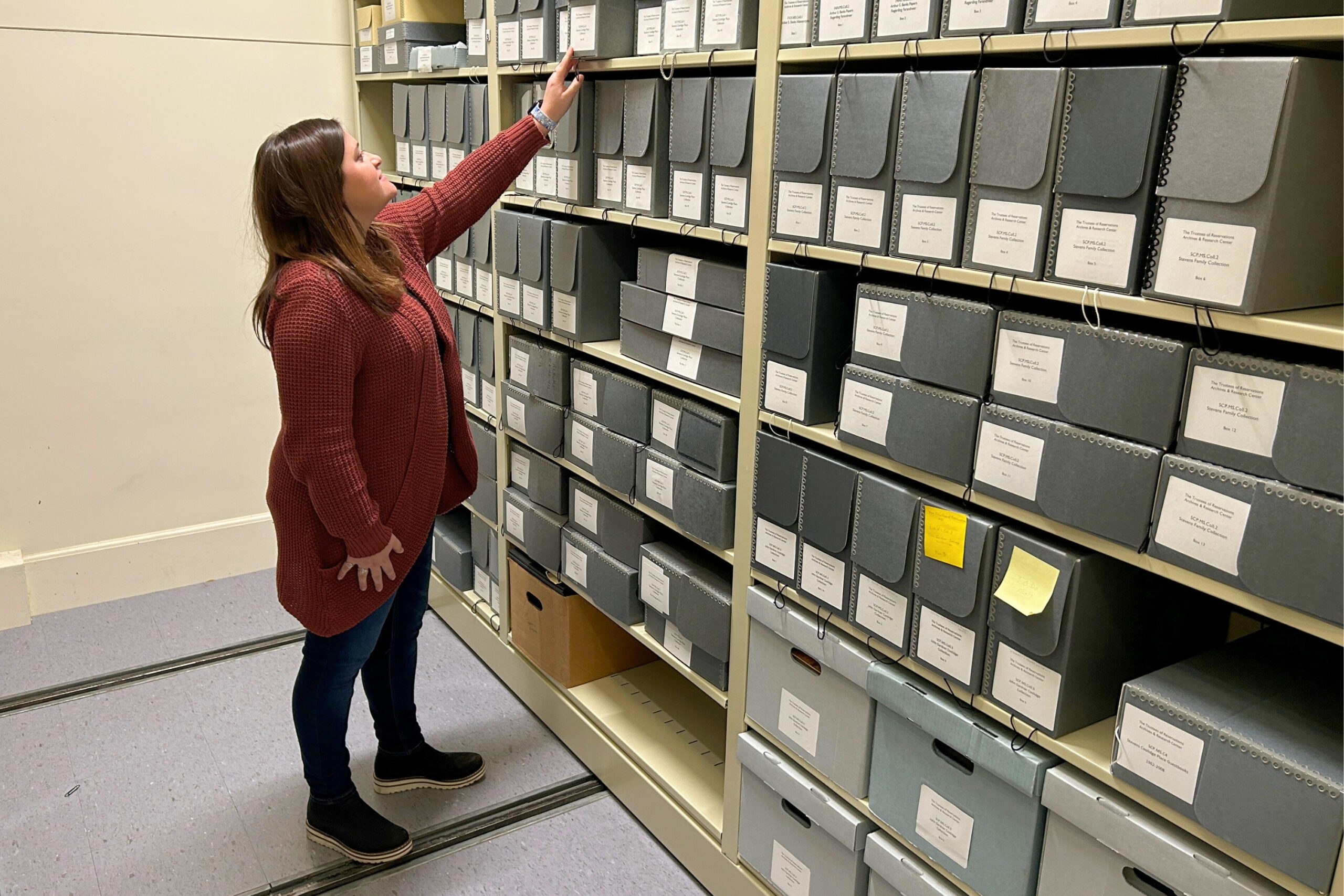
Trustees Archivist Madison Mark pulls a box of archival materials off one of the Archives & Research Center’s stacks.
Rolling dunes, towering forests, sprawling farms, looming mountains, inspiring museums, enduring structures—the diversity of special places The Trustees cares for is staggering. However, the organization’s responsibility extends far beyond natural landscapes and unique buildings. There is also an often-unseen element just as critical to the role of forever stewards: the historic collections.
“We are preserving Massachusetts’ history for everyone, forever,” said Trustees Archivist Madison Mark. “A lot can be learned from even the most mundane objects…you never know how important saving an item for future generations might be.”
Stewarding paintings, manuscripts, and textiles—acquired from more than 100 historical collections on Trustees properties across Massachusetts—requires an immense amount of delicacy, attention to detail, and continual learning. That work falls largely to the Historic Collections Team who manage several storage facilities including the Archives & Research Center (ARC) in Sharon, where 7,500 square feet of climate-controlled storage and 6,000 linear feet of high-density compact shelving are required to preserve many thousands of objects.
Handling Historical Objects
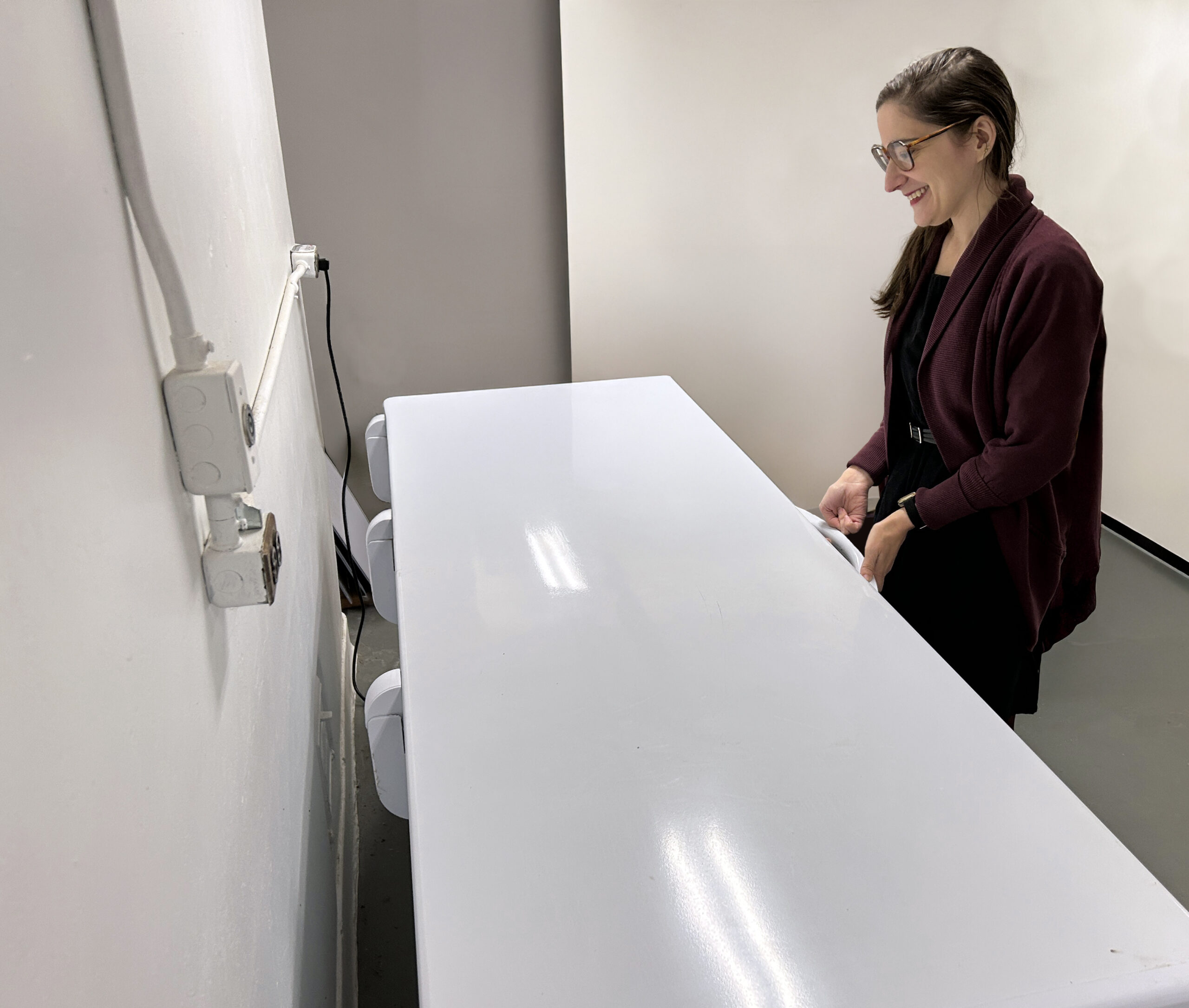
Trustees Collection Manager Anna Thompson opens a chest freezer in the basement of the Archives & Research Center which houses quarantined and delicate historical objects.
The ARC’s storage rooms are crowded with ornate dinner plates, mirrors the size of cars, paintings, and a plethora of antique chairs (by far the most popular item preserved there). Each object officially belongs to a place under Trustees care—from protected New England estates to ecological habitats—but their original environments are usually not the best places to preserve these delicate items.
“It’s important for us to be able to welcome visitors to our sites, but it can be difficult to open the space safely to visitors with all items still in place,” said Collections Manager Anna Thompson. “Some items like textiles and photographs are too fragile to remain at the properties and require a different level of care.”
“Whenever possible, we help properties make reproductions of photographs, family trees, and other items to display on site,” added Archivist Sarah Hayes. “That way people are still able to interact with the collections during their visit while we’re able to preserve the original objects for future generations.”
When an item does arrive at the ARC or other storage facility, it must be quarantined. This allows for items to climatize to their new environment and ensures staff have the chance to examine the materials and identify those needing special treatment. Depending on the issue, objects may need to undergo low temperatures, high temperatures, or anoxic (lack of oxygen) treatments to eliminate pests and spores. Some of this work can be done in house by the Historic Collections Team, but more complicated projects require specialized equipment like the anoxic bubble at Historic New England.
“A large part of my job is monitoring and assessing the risk of pests, dust, and mold in the collections both at the properties and in the storage facilities,” said Thompson. “Air circulation from our climate-control systems helps minimize dust and stabilize humidity. Certain environmental conditions can favor infestations, so we try to mitigate those factors. We have multiple large chest freezers across the state—including at the ARC—to treat moth, beetle, mold, and other pest issues utilizing low temperature treatments.”
Conserving Stacks of Manuscripts & Textiles
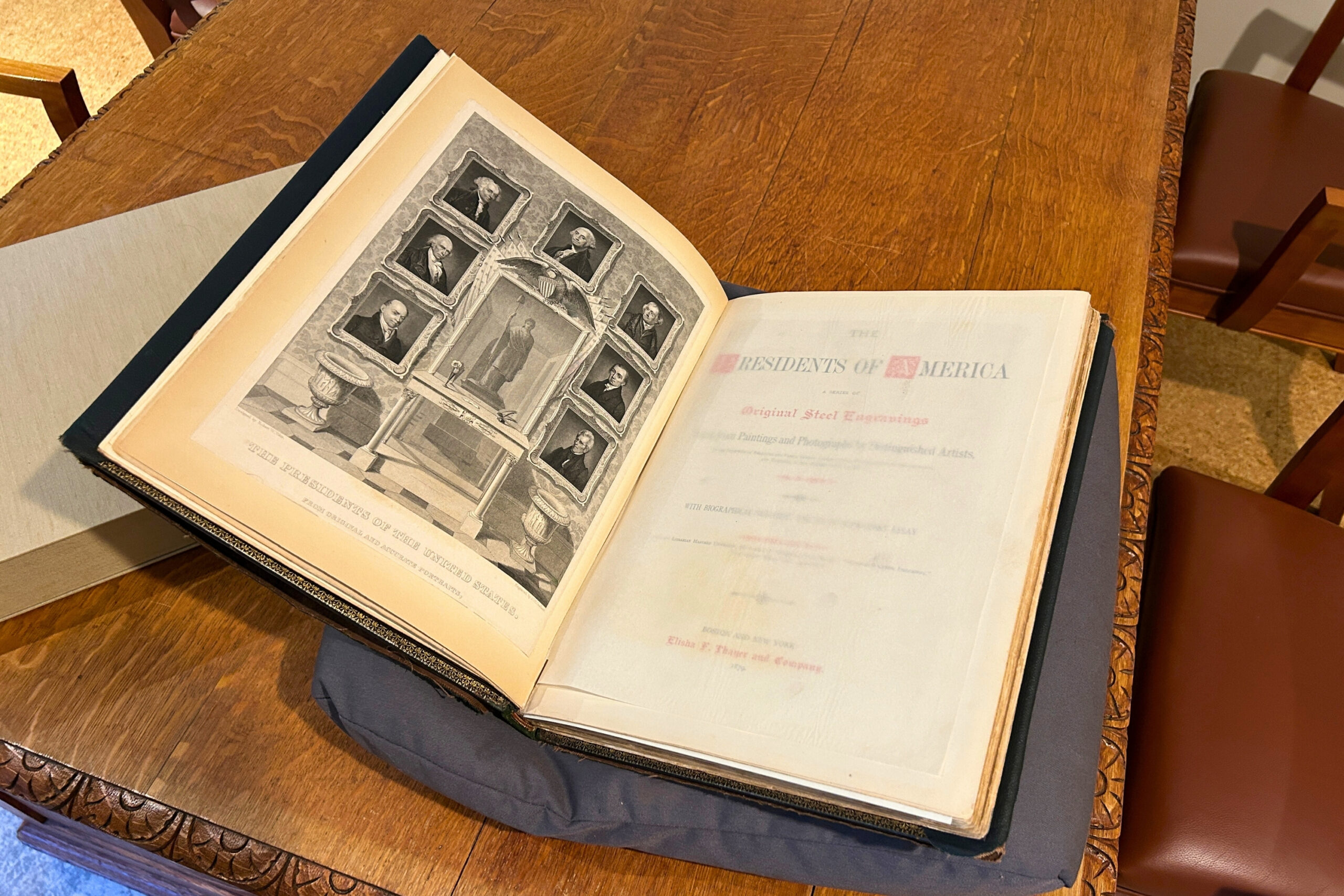
“The Presidents of America” (1879) housed with the Appleton Farms collection at the Archives & Research Center.
Once the manuscripts, dried plant materials, architectural fragments, and other items are deemed safe, they are integrated with the rest of the collections. At the ARC, most objects are stored in the stacks: 65 floor-to-ceiling compact shelving units, broadside cabinets, and painting racks in climate-controlled rooms with industrial dehumidifiers. For additional protection, materials are housed in folders, boxes, and other enclosures specifically designed and tested to safeguard against significant degradation.
One of many interesting heirlooms housed here comes from the Appleton family of Appleton Farms in Ipswich & Hamilton: a book entitled The Presidents of America (1879). While the book itself is not a unique publication, the Appletons collected and added original presidential letters to the pages, complete with signatures and wax seals. There’s even a personal correspondence from President Theodore Roosevelt to the Appletons’ request for his signature, as he was a family friend.
Treatment to address wear and tear on manuscripts such as this is another part of the Historic Collections Team’s conservation work. In 2016, The Presidents of America was sent to the New England Document Conservation Center (NEDCC) for additional conservation treatment. They cleaned the pages, patched the leather bindings, and added buffer barrier sheets between each page. NEDCC also crafted custom housing for the book to provide additional protection.
“There’s no one-size-fits-all answer to housing items,” said Mark. “You learn the standards in school, but then you have to constantly adapt to the item, the collection, and the context as you continue to work with it and learn new things.”
Supporting Research
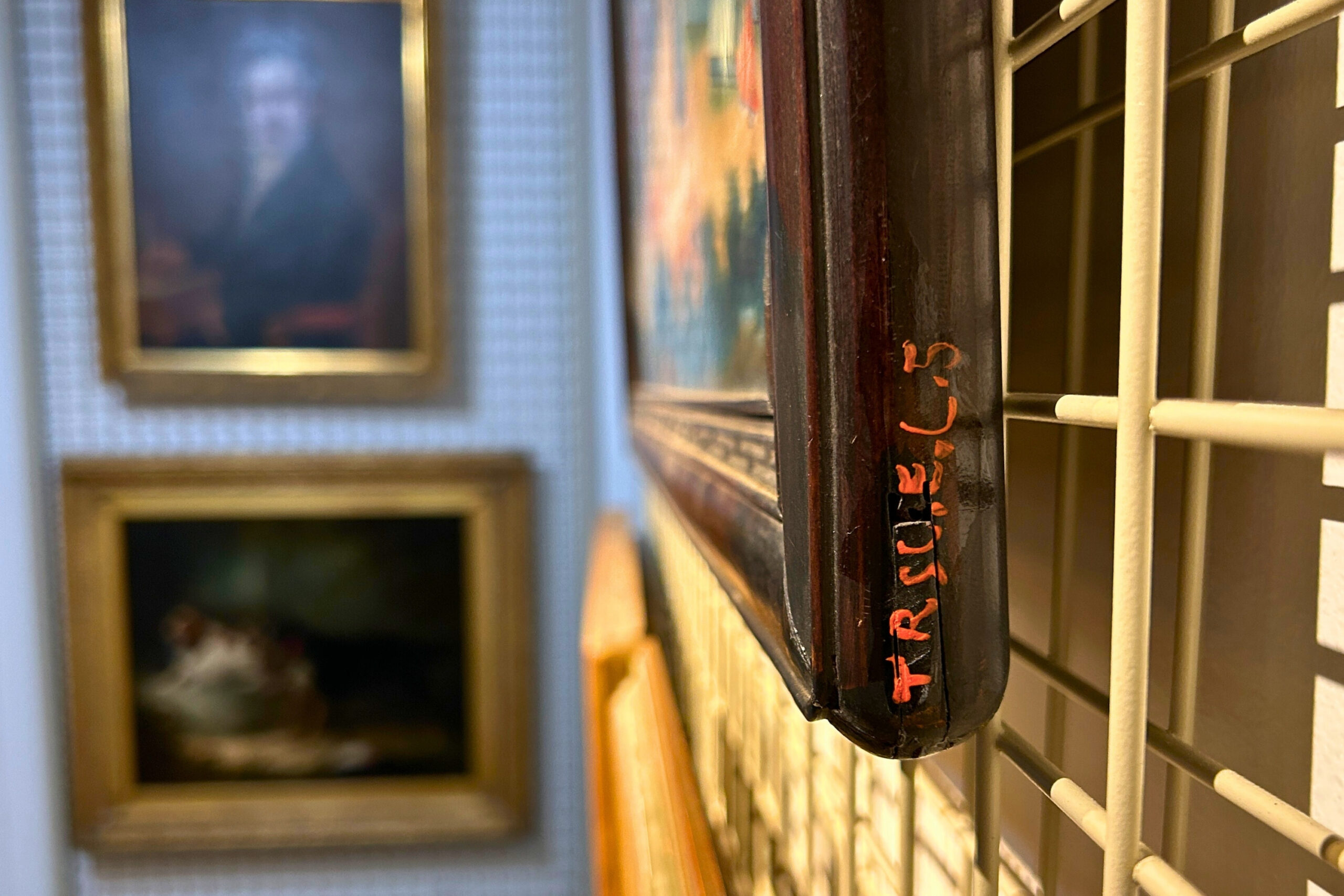
Each collection item is assigned a specific code for future identification and research. This painting’s code represents “TR” (Trustees), “SC” (Stevens-Coolidge House & Gardens), “E” (dining room), “C” (artwork), “5” (fifth piece of artwork catalogued from this room).
Supporting research—both internal from fellow Trustees staff and external from organizations, universities, and individuals—was one of the major factors that lead to the formation of this central repository back in 2008. Several groundbreaking discoveries have occurred since then.
“One of my favorite recent memories was working with Dr. Paul D’Ambrosio [President and CEO of the Fenimore Art Museum],” said Thompson. “I found a carte de vista [a calling card-sized photograph popular in the mid-19th century] while gathering materials for his research, and it turned out to be the only known photograph in existence of influential American painter William Matthew Prior.”
The Historic Collections Team works hard to make sure the items at the ARC and the other Trustees collection storage sites are well cared for. By stewarding these treasures with expertise and intention, this team is ensuring that knowledge can continue to inform and inspire well into the future. After all, The Trustees are not only responsible for protecting natural landscapes and distinctive buildings, but the legacy these special places hold, for everyone, forever.
Please Note: To make a research request, fill out the Research Request Form or email arc@thetrustees.org to make an in-person appointment (appointments are required; walk-ins cannot be accommodated).